
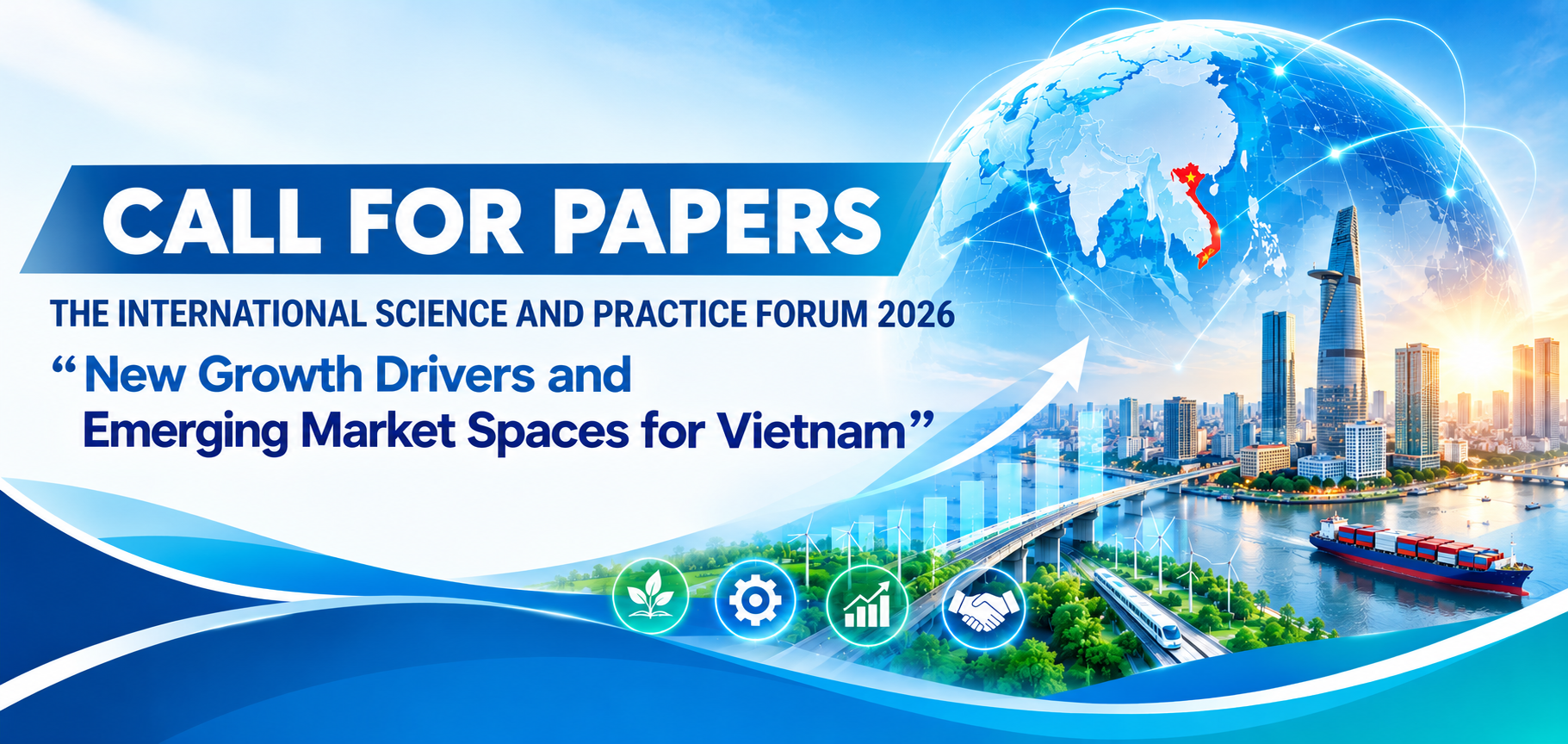
Thông báo mời viết bài tham dự Diễn đàn khoa học và thực tiễn quốc tế 2027 “Động lực tăng trưởng và các không gian thị trường mới của Việt Nam” (International Science and Practice Forum 2027 New Growth Drivers and Emerging Market Spaces for Vietnam)
CALL FOR PAPERS
The International Science and Practice Forum 2026 “New Growth Drivers and Emerging Market Spaces for Vietnam”
The University of Finance – Marketing cordially invites scholars, researchers, and experts to submit original research papers and scholarly contributions to the International Science and Practice Forum 2026, themed “New Growth Drivers and Emerging Market Spaces for Vietnam.” The Forum aims to foster scholarly dialogue, critical discussion, and evidence-based recommendations for accelerating sustainable economic growth, transforming Vietnam’s growth model, and expanding emerging market opportunities. It also seeks to strengthen connections among academic research, policymaking, business needs, and postgraduate education. Particular emphasis will be placed on the Halal economy as a strategic avenue for participation in global value chains and international markets.
1. Suggested Topics
- Drivers and enabling conditions for high and sustainable growth; transformation of growth models, productivity, and the quality of economic growth.
- Science and technology, innovation, digital transformation, artificial intelligence, and competitiveness.
- Institutions, the business environment, human capital, the private sector, investment, capital markets, and financial resources for growth.
- The green economy, logistics, regional connectivity, value chains, and emerging market spaces; international experience and implications for Vietnam.
- The Halal economy: global trends, standards and certification, export markets, supply chains, logistics, tourism, services, finance, and Halal ecosystem development.
- Case studies, research institute–university–industry collaboration models, knowledge transfer, market development solutions, and policy recommendations.
2. Contributions and Publication
The Organizing Committee welcomes submissions that articulate clear research questions, employ appropriate methodologies, present reliable evidence and original findings, and offer feasible policy or managerial implications. Papers meeting academic standards will be considered for peer review and selection for inclusion in the conference proceedings, in accordance with the applicable regulations. Selected findings may also be synthesized into policy advisory reports, thematic reports, or proposals for subsequent research collaboration.
The Organizing Committee also warmly invites experts and scholars to engage in academic discussions and scholarly review with doctoral candidates and master’s students, helping to enhance the quality of research, supervision, and academic publication in postgraduate education.
2. Date and venue
- Date: November 26th – 28th, 2026.
- Venue: University of Finance – Marketing, HCMC, Vietnam.
3. Submission guidelines
- Abstract submission deadline: October 28, 2026.
- Full-paper submission deadline: November 16, 2026.
- Submission link: https://forms.gle/AHhEaUpzXE4cYL3U8
- Detailed manuscript requirements: See the attachment.
- Submissions must present original, independent research that has not been previously published.
- High-quality submissions that successfully undergo peer review will be published in the conference proceedings.
- For further inquiries, please contact us at: hoithaokhoahoc@ufm.edu.vn.
The Organizing Committee looks forward to receiving your interest and valuable scholarly contributions.
Yours sincerely./.
DETAILED MANUSCRIPT SUBMISSION REQUIREMENTS
1. General Requirements
- Language: English.
- Length: 3,000–6,000 words, excluding references and appendices.
- Format: Microsoft Word document; A4 paper; Times New Roman, 13-point font.
- Submissions must comply with applicable academic standards and policies on citation, textual similarity, and the use of artificial intelligence in scholarly work.
2. Manuscript Requirements
2.1. Title
The title should be concise and informative, contain no more than 20 words, and accurately reflect the main focus of the paper.
2.2. Authors and Affiliations
Provide each author’s full name, academic title, institutional affiliation, email address, and telephone number.
2.3. Abstract
The abstract should comprise a single paragraph of 150–200 words and clearly summarize: (i) the research objectives; (ii) the methodology; (iii) the sample size and research data; and (iv) the principal findings.
2.4. Keywords
Provide 3-5 keywords that characterize the subject of the paper, arranged in alphabetical order.
2.5. Manuscript Structure
2.5.1. Introduction or Problem Statement
The introduction should explain (i) the rationale for the study and its theoretical and practical significance; (ii) the research problem; and (iii) the key issues addressed in the paper.
2.5.2. Literature Review and Theoretical Background
Present (i) a critical review of the relevant literature and underlying theories; and (ii) the theoretical or analytical framework employed in the study.
2.5.3. Research Methodology
Authors may adopt qualitative, quantitative, or mixed methods, as appropriate to their research approach. This section should describe the research model and hypotheses (for quantitative studies) and/or qualitative research design, together with the methods of data collection.
2.5.4. Results and Discussion
Interpret and analyze the principal and novel findings, highlighting their relationships with and contributions to existing research. For policy-oriented, advisory, or expert commentary papers, this section may instead focus on evaluating the current state of the issue under investigation, including achievements, limitations, and underlying causes.
2.5.5. Conclusions and/or Recommendations
In line with the study objectives, present conclusions and, where appropriate, evidence-based solutions or recommendations for business managers and/or policymakers.
2.5.6. Citations and References
In-text citations and reference lists must follow APA style.
Example:
Stanton, G. C. (2008). Education in the minds of millions. Education Quarterly, 5(13), 567–580.
Duenwald, M., Ronald, R. P., & Smith, J. W. (2004). Addiction and environmental change. Pearson Education.